
These Universe and Solar System Notes are based on Parmar SSC & Lucent Books and are available for download in this post.
UNIVERSE & ASTRONOMY
- Study of Universe → Cosmology
- Branch of science dealing with celestial bodies → Astronomy
- Universe consists of many Galaxies, and a galaxy consists of many Solar Systems.
ORIGIN OF UNIVERSE
- Big Bang Theory → Proposed by George Lemaître (1927) and published in 1931.
- Also known as Big Bang Explosion Theory.
- Universe originated from an infinitely hot and dense single point (Singularity).
- Big Bang occurred about 13.8 billion years ago.
- Led to the formation of galaxies, stars and other heavenly bodies.
- Steady State Theory → Proposed by Fred Hoyle, Hermann Bondi and Thomas Gold.
- Universe is continuously expanding, but its average properties remain unchanged.
GALAXY
- A galaxy is a massive collection of stars, gas, dust and dark matter held together by gravity.
- Our galaxy → (Akash Ganga).
- Milky Way formed after the Big Bang.
- Nearest galaxy to the Milky Way → .
- Solar System is located in the Orion Arm (Orion Spur).
ORIGIN OF SOLAR SYSTEM
- Solar System formed about 4.5 billion years ago.
- A cloud of gas and dust collapsed to form a spinning disk called the Solar Nebula.
- Gravity formed the Sun at the centre, while the remaining material formed planets.
- Dust and gas formed planetesimals, which merged to form planets.
- This is the most widely accepted hypothesis.
- Energy in the Sun is produced by fusion of hydrogen nuclei.
- Planetesimal Theory → Proposed by and (1905).
- Nebular Hypothesis → Proposed by (1755) and expanded by (1796).
- Age of Earth → 4.5 billion years.
SOLAR SYSTEM
- Total planets → 8
- Dwarf planets → 5
- Sun is at the centre of the Solar System.
- Sun is the brightest and nearest star to Earth.
- Sun constitutes about 99.86% of the Solar System’s total mass.
- Copernicus Theory (1543) / Heliocentric Theory → Proposed by .
- States that the Sun is at the centre and planets revolve around it.
CELESTIAL BODIES
- Celestial bodies are objects in space such as planets, stars, moons, asteroids, comets, meteoroids, meteors, meteorites and galaxies.
- Luminous Bodies → Emit their own light. Example: Stars.
- Non-Luminous Bodies → Do not emit their own light. Examples: Moon, Comets, Asteroids, Meteoroids, Meteors and Meteorites.
COMETS
- Large icy objects orbiting the Sun.
- Made of dust, rock and frozen gases such as water, carbon dioxide, ammonia and methane.
-
- Appears every 76 years
- Last seen in 1986
- Expected again in 2061
ASTEROID
- Rocky, metallic or icy object orbiting the Sun.
METEOROID
- Small rocky or metallic body orbiting the Sun.
- Smaller than asteroids, ranging from dust grains to about 1 metre in size.
METEOR
- When a meteoroid enters Earth’s atmosphere (Mesosphere) and burns, it becomes a Meteor (Shooting Star).
- Quadrantids Meteor Shower is visible in early January.
METEORITE
- If a meteoroid survives atmospheric entry and reaches Earth’s surface, it is called a Meteorite.
THE SUN
- Only star of the Solar System.
- Powerhouse of the Solar System.
- Composition:
- Hydrogen → 73%
- Helium → 25%
- Other elements → 2%
- Distance from Earth → 149.6 million km (15 crore km).
- Speed of Light → 3 lakh km/second.
- Time taken by sunlight to reach Earth → 8 minutes 20 seconds.
- Surface Temperature (Photosphere) → 5800 K (~5600°C).
- Core Temperature → 15.7 million K.
CONSTELLATIONS
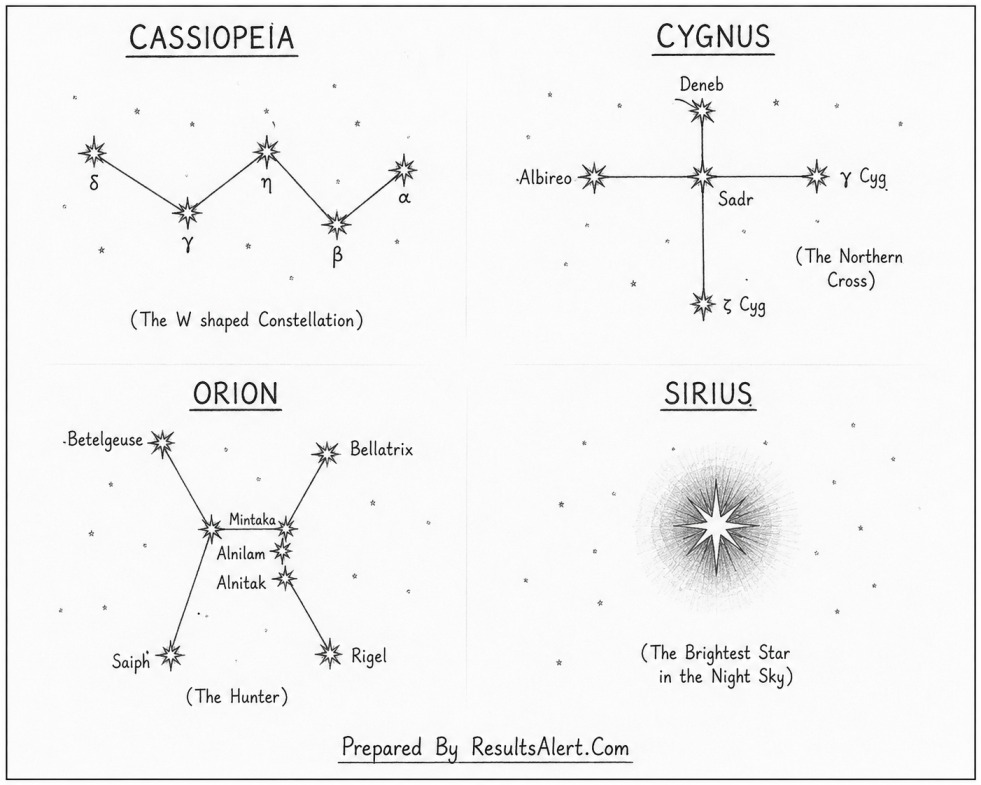
- A constellation is a group of stars forming a recognizable pattern in the night sky.
- Every constellation forms an Asterism.
- Ursa Major
- Also called Great Bear and Saptarishi.
- Contains the Big Dipper asterism.
- Cassiopeia
- W-shaped constellation.
- Brightest star → Schedar (Alpha Cassiopeiae).
- Cygnus
- Prominent northern constellation with a cross shape.
- Sagittarius
- Bow-and-arrow shaped constellation.
- Orion (The Hunter)
- Visible during winter in the northern sky.
- Brightest star → Rigel.
- Brightest star in the night sky → .
- Nearest star to Earth after the Sun → .
ASTRONOMICAL DISTANCE UNITS
- Light Year
- Distance travelled by light in one year.
- 1 Light Year = 9.461 × 10¹² km
- Parsec
- 1 Parsec = 3.26 Light Years
LAYERS OF THE SUN
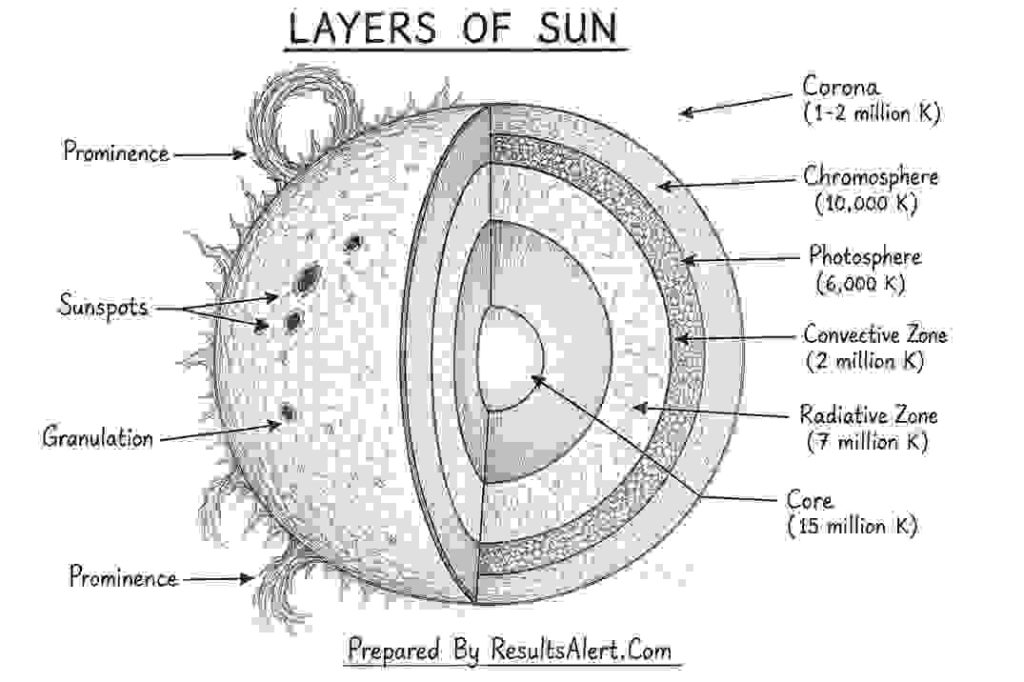
- Photosphere → Visible surface of the Sun.
- Chromosphere → Reddish layer above the photosphere.
- Corona → Outermost layer of the Sun’s atmosphere, visible during a total solar eclipse and hotter than the photosphere.
PLANETS
- Terrestrial Planets (Inner Planets) → Mercury, Venus, Earth, Mars
- Small in size
- Rocky composition
- Solid surface
- Near the Sun
- Few or no moons
- No rings
- Jovian Planets (Outer Planets) → Jupiter, Saturn, Uranus, Neptune
- Very large
- Gaseous composition
- No solid surface
- Far from the Sun
- Many moons
- Ring systems present
- Gas Giants → Jupiter, Saturn
- Ice Giants → Uranus, Neptune
MERCURY
- Closest planet to the Sun.
- Smallest planet in the Solar System.
- Diameter → 4,900 km.
- Fastest planet.
- Orbital speed → 172,300 km/hour (47 km/s).
- Revolution period → 88 days.
- No significant atmosphere.
- No natural satellite.
VENUS
- Hottest planet in the Solar System.
- Known as Earth’s Twin.
- Brightest planet in the Solar System.
- Visible during morning and evening.
- Slowest rotating planet.
- Rotation period → 243 Earth days.
- Covered with thick clouds of Sulphuric Acid (H₂SO₄).
- Other names → Morning Star, Evening Star, Lucifer.
- Has no natural satellite.
- Rotates from East to West.
EARTH
- Only known planet that supports life.
- Known as the Blue Planet.
- About 70% covered by water.
- One natural satellite → Moon.
- Highest density among planets → 5.5 g/cm³.
- Closest planet to Earth → Venus.
MARS
- Known as the Red Planet.
- Second smallest planet after Mercury.
- Natural satellites → Phobos and Deimos.
- Thin atmosphere with valleys, craters, deserts and ice caps.
- Olympus Mons is the largest volcano and tallest mountain in the Solar System.
- Height → 22–25 km.
- Length of a Martian day → 24 hours 37 minutes.
ASTEROID BELT
- Located between Mars and Jupiter.
- asteroid → 2006 VP32.
- studied by NASA’s OSIRIS-REx Mission.
JUPITER
- Largest planet in the Solar System.
- Fastest rotation → 9 hours 55 minutes.
- Atmosphere mainly Hydrogen and Helium.
- Third brightest object after Moon and Venus.
- Contains Great Red Spot.
- Has 95 known moons.
- Major moons → Io, Europa, Ganymede, Callisto.
- Known as Galilean Moons.
- Ganymede is the largest moon in the Solar System.
SATURN
- Second largest planet.
- Famous for ring system made of ice and rocky particles.
- Least dense planet → 0.69 g/cm³.
- Can theoretically float on water.
- Has 274 known moons.
- Largest moon → Titan.
- Titan and Enceladus show possibilities of life.
- discovered rings in 1655.
- discovered ring gap in 1675.
- Rotation period → 11 hours.
URANUS
- Known as the Green Planet.
- Green colour due to Methane.
- Discovered by (1781).
- Coldest planetary atmosphere.
- Has at least 27 moons.
- Important moons → Miranda, Ariel, Umbriel.
- Axis tilted by 98°.
- Known as Rolling Planet/Lopsided Planet.
- Rotation period → 17 hours.
- Rotates from East to West.
NEPTUNE
- Farthest planet from the Sun.
- Revolution period → 165 years.
- Rotation period → 16 hours.
- Bluish colour due to Methane.
- Atmosphere mainly Hydrogen and Helium.
- Windiest planet.
- Discovered by and (1846).
- First planet discovered through mathematical prediction.
- Has 14 moons.
- Most famous moon → Triton.
- Has faint rings.
PLANETS IN DECREASING ORDER OF SIZE
- Jupiter → Saturn → Uranus → Neptune → Earth → Venus → Mars → Mercury
MOON
- Earth’s only natural satellite.
- Non-luminous body.
- Radius → 1.74 × 10⁶ m (1,740 km).
- Thin atmosphere called Lunar Exosphere.
- Moonlight takes 1.26 seconds to reach Earth.
- Distance from Earth → 384,000 km.
- Gravity on Moon → 1/6th of Earth’s gravity.
- Only one side is normally visible from Earth.
- Rotation period = Revolution period = 27.3 days.
- Highest point → Mons Huygens (formerly Mt. Leibniz).
SOLAR MISSIONS
-
- India’s first solar observatory mission.
- Launched by .
- Studies the Sun.
- Located at L1 Lagrange Point.
LAGRANGE POINTS
- Positions where gravitational forces of two large bodies balance centripetal force.
- Total → 5 (L1–L5).
CHANDRAYAAN-3
- Third lunar mission of .
- Lander → Vikram
- Rover → Pragyan
- Landing site → Shiv Shakti Point
- Landed near the Lunar South Pole.
INTERNATIONAL ASTRONOMICAL UNION (IAU)
- Headquarters →
KUIPER BELT
- Ring-shaped region beyond Neptune.
- Contains asteroids, comets and dwarf planets.
- Pluto is a member of the Kuiper Belt.
PLUTO
- Discovered by .
- Removed from the list of planets by IAU in 2006.
- Classified as a dwarf planet.
- Largest moon → Charon.
- Total moons → 5.
- Revolution period → 248 Earth years.
- Orbit overlaps with Neptune’s orbit.
DWARF PLANETS
- Orbit the Sun.
- Nearly spherical in shape.
- Cannot clear their orbital neighbourhood.
MAJOR DWARF PLANETS
- Pluto → Largest and brightest dwarf planet.
- Eris → Second largest dwarf planet.
- Makemake → Third largest dwarf planet; revolution period about 310 years.
- Haumea → Fastest rotating dwarf planet in the Kuiper Belt.
- Ceres → Located in the Asteroid Belt.
INTERNATIONAL SPACE STATION (ISS)
- Completes one orbit around Earth in 90–93 minutes.
IMPORTANT TERMS
- Supernova → Explosion of a star.
- Pulsar → Rapidly rotating neutron star.
- Black Hole → Region in space with extremely strong gravity from which even light cannot escape.
- Van Allen Radiation Belts → Two concentric belts of charged particles surrounding Earth.